CYNDUSTRIES The signal path, taken slowly.

Home / Signal & Path

Signal & Path

Gates Hold; Triggers Fire

A gate is a duration; a trigger is a moment. Confusing them wastes patches and puzzles envelopes.

By the Cyndustries bench · Signal & Path · 4 min read

The Difference Is Time

A gate signal is high voltage for as long as the event lasts — a key held down, a sequencer step with its length set wide, a logic output staying true. Its falling edge carries information just as much as its rising one. An ADSR envelope reads that duration: attack climbs when the gate opens, sustain holds as long as voltage stays high, release begins when the gate closes. Pull the gate away early and the envelope cuts to release before the sustain completes. That is not a bug; it is the whole point.

A trigger is a brief pulse — typically a few milliseconds of high voltage, then back to zero regardless of what caused it. The trigger communicates that something happened, not how long it lasts. Modules built around triggers — clock dividers, drum voice inputs on many envelope generators, Buchla-style function generators configured for cycling — care only about the edge. They fire and complete their cycle on their own schedule, indifferent to what the sending module does afterward.
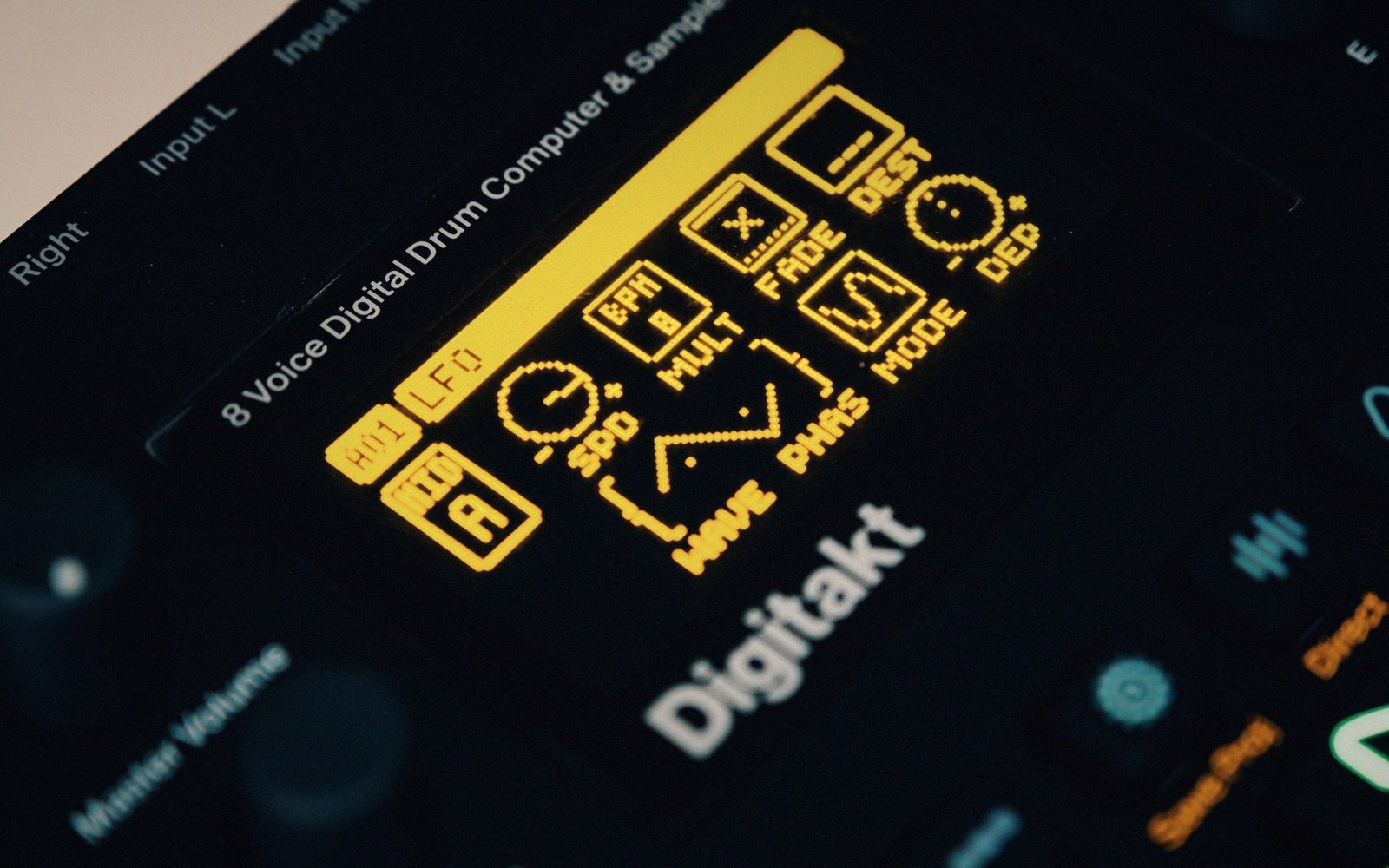
Close-up of a Digitakt drum computer screen showing LFO parameter icons in yellow
A gate is a duration; a trigger is a moment. Confusing them wastes patches and puzzles envelopes. — Photo: Egor Komarov / Pexels

What Breaks When You Mix Them

Send a gate to a trigger-only input and most drum envelope circuits will fire correctly on the rising edge, but if the gate is long enough, a retrigger may happen or nothing unusual occurs — the circuit ignores the tail. That one often works by accident.

The damaging case runs the other way. Send a short trigger to an ADSR expecting a held gate and the envelope immediately enters release at whatever point attack reached — because the gate closed before the sustain stage was reached. Pads vanish. Slow attacks never complete. This is the single most common reason a new patch sounds wrong without any obvious cable mistake.

The fix is almost always a gate-length utility — a simple module or slew circuit that stretches a trigger into a held gate of configurable duration. Some sequencers offer gate-length control per step; if yours does, that is the first place to look. If it does not, a dedicated gate expander or even a short-attack, slow-decay envelope feeding a comparator can manufacture a gate from a trigger.

Reading "Voltage Is the Language" makes the underlying logic clearer: these are not different types of signals in a categorical sense — they are the same voltage range interpreted across different spans of time.

What goes wrong

  • Trigger into an ADSR: envelope enters release before sustain is reached; pads truncate, slow attacks fail
  • Gate into a trigger input: usually works by accident on the rising edge; retrigger possible on very long gates

Follow a cable