CYNDUSTRIES The signal path, taken slowly.

Home / Building A Rig

Building A Rig

Format Differences That Actually Matter

Rail voltages, HP widths, and signal levels: what separates Eurorack, 5U, and Buchla-style formats isn't brand loyalty — it's physics.

By the Cyndustries bench · Building A Rig · 4 min read

Fed by

Nothing yet — this is a loose jack. It is a legitimate place to start.

The Numbers Behind the Names

Eurorack runs on ±12 V rails with a 5 V rail often present but inconsistently used. Modules are measured in horizontal pitch (HP), where 1 HP equals 5.08 mm — the same increment as rack-mount equipment going back to telephone switching gear. A standard Eurorack case is 3U tall, where U is the 1.75-inch unit of rack height. A module 8 HP wide is 40.64 mm across. Audio signals in Eurorack conventionally run at roughly 10 V peak-to-peak, though this is a convention rather than a hard specification; some modules run hotter. Control voltages are typically 0–5 V or ±5 V depending on whether the signal is unipolar or bipolar.

5U — often called MU format or Moog Unit format, associated with the synthesizer work done by Robert Moog and later standardized by Synthesizers.com and others — runs on ±15 V rails. Module width is measured in inches, with a single module typically 2.125 inches wide. The case height is, as the name implies, 5U: 8.75 inches. That extra rail voltage headroom matters directly: audio signals in 5U systems commonly run at around 10–15 V peak-to-peak, and the higher supply voltage gives op-amp circuits more headroom before they clip. The format also uses 3.5 mm jacks in some implementations and quarter-inch jacks in others — this varies by manufacturer and era.

Buchla-style format — associated with Don Buchla's designs beginning in the 1960s and now carried forward by Buchla Electronic Musical Instruments and a handful of compatible makers — also runs on ±15 V rails, though the physical format differs significantly from 5U MU. Buchla systems use a proprietary power connector and a banana jack patching convention rather than 3.5 mm or quarter-inch TRS. Banana jacks allow signal stacking without Y-cables: two banana plugs share the same jack physically, which changes patching workflow in a practical way. Signal levels and CV conventions in Buchla-adjacent systems can differ from both Eurorack and 5U, and the ecosystem is deliberately less standardized; what passes between modules as a "gate" or a "CV" is not always interchangeable even within the format.
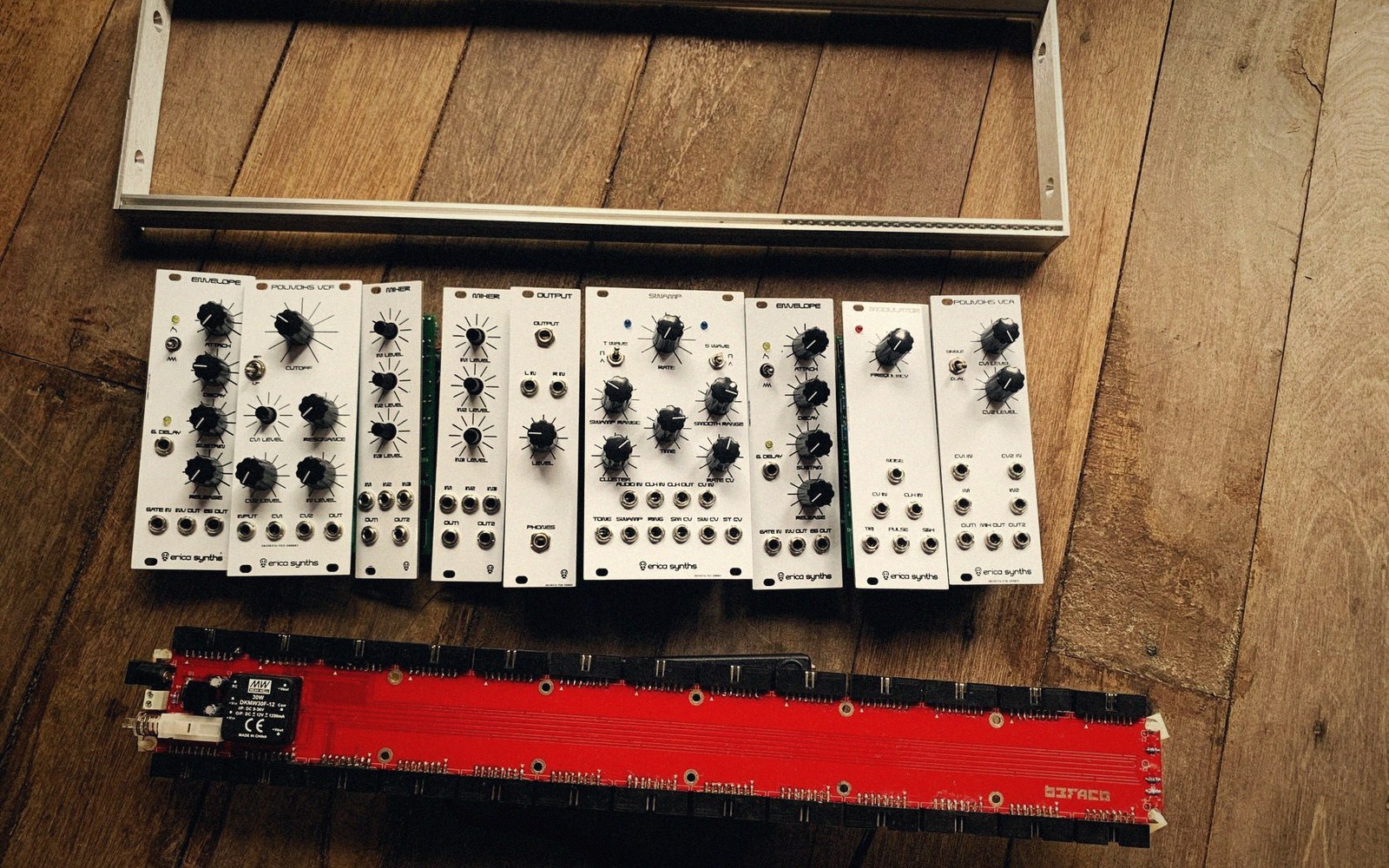
Eurorack synthesizer modules with knobs laid out above a red power bus board
Rail voltages, HP widths, and signal levels: what separates Eurorack, 5U, and Buchla-style formats isn't brand loyalty — it's physics. — Photo: Alexey Demidov / Pexels

What This Means If You're Mixing Formats

The short answer is: mixing formats is possible but requires deliberate level translation, and it's easy to underestimate the work involved.

The most common cross-format situation is someone running a Eurorack case who wants to incorporate a 5U oscillator or filter. Rail voltage is the first practical barrier — you cannot power a ±15 V module from a ±12 V supply and expect it to behave correctly; components that rely on that voltage for bias points will be running outside their design parameters. You need either a separate 5U power supply or a dedicated converter that generates ±15 V within the Eurorack case. Some converters exist for exactly this, but they occupy HP and draw from your Eurorack supply.

Signal level is the second issue. A 5U VCO running at ±15 V rails may output a signal swing of 14 V peak-to-peak. Feeding that into a Eurorack module expecting 10 V peak-to-peak will clip or overdrive the input stage, sometimes interestingly, sometimes damagingly — know which before you patch. Attenuators and depth control on modulation signals apply here as much as anywhere in the signal path. Going the other direction, a Eurorack LFO outputting ±5 V fed into a 5U VCO expecting a ±5 V or 0–10 V CV input will likely work with attention to offset and scaling, but the 1V/oct calibration standard needs verifying in both directions.

The pitch CV standard is a rare point of compatibility. Both Eurorack and 5U generally agree on 1 V/octave for pitch tracking — this was Moog's contribution to the architecture, and it carried forward. Buchla systems historically used a different convention (1.2 V/octave) in some modules, which matters immediately if you're trying to sequence a Buchla-style oscillator from a Eurorack sequencer.

Format choice early in a build shapes everything downstream: the power infrastructure, the physical size of the case, the signal levels your modules expect, and how much translation work any future expansion requires. None of those constraints are deal-breakers — they're engineering facts, and engineering facts are workable once they're visible.

Physical format quick reference

  • 1 HP = 5.08 mm (Eurorack)
  • 1U = 1.75 inches rack height
  • Eurorack case height: 3U (5.25 in); 5U case height: 8.75 in
  • Eurorack uses 3.5 mm mono jacks throughout; 5U uses 3.5 mm or ¼-inch depending on maker; Buchla uses banana jacks

Follow a cable