CYNDUSTRIES The signal path, taken slowly.

Home / Modulation

Modulation

When the Audio Rate Becomes the Modulator

Below a few hertz, modulation shapes a sound over time. Above it, modulation becomes the sound itself.

By the Cyndustries bench · Modulation · 2 min read

Fed by

Nothing yet — this is a loose jack. It is a legitimate place to start.

The Threshold Is Not a Line

Slow down any audio oscillator far enough and it becomes an LFO. Speed up any LFO past roughly 20 Hz and it enters the audible range. The physics are identical; only the perceptual result changes. This is the key insight behind audio-rate modulation: there is no fundamental difference between a modulator running at 0.3 Hz and one running at 300 Hz. Both are voltages varying over time, both are moving a destination parameter. What changes past the hearing threshold is that the ear stops tracking the variation as movement and starts hearing it as texture.

Patch a slow sine into a VCO's pitch input and you hear vibrato — a recognisable wobble, the carrier's pitch rising and falling periodically. Increase the modulator's frequency through 5, 10, 20 Hz and the wobble tightens, becomes a roughness, then a smear, then — past roughly 20–30 Hz — something categorically different: new frequency components, audible as additional pitches, appearing around and between the carrier. The listener is no longer aware of modulation happening. They hear a timbre.

What FM Actually Does to the Waveform

In frequency modulation, the modulating signal varies the instantaneous frequency of the carrier. At audio rates this happens fast enough that the carrier waveform is being bent and stretched within individual cycles. The mathematics, worked out by John Chowning at Stanford in the late 1960s, shows that a sine carrier modulated by a sine produces sidebands at frequencies equal to the carrier frequency plus and minus integer multiples of the modulator frequency. The ratio of carrier to modulator — the C:M ratio — determines which sidebands appear and therefore what harmonic or inharmonic character the result takes on. A ratio of 1:1 produces sidebands that sit on harmonics of the fundamental; a ratio of 1:1.41 scatters them into inharmonic territory, useful for metallic and bell-like sounds. The modulation depth — how much the modulator actually deflects the carrier's frequency — controls the amplitude of those sidebands. Deeper modulation adds higher-order sidebands and a denser, more complex spectrum.

In analog Eurorack contexts, the modulator goes into the FM input rather than the 1V/oct input, because the modulation depth needs independent control and the 1V/oct tracking needs to stay clean. A dedicated FM attenuator on the oscillator sets the depth; without it, even small audio signals at the FM input can push modulation far beyond useful range.
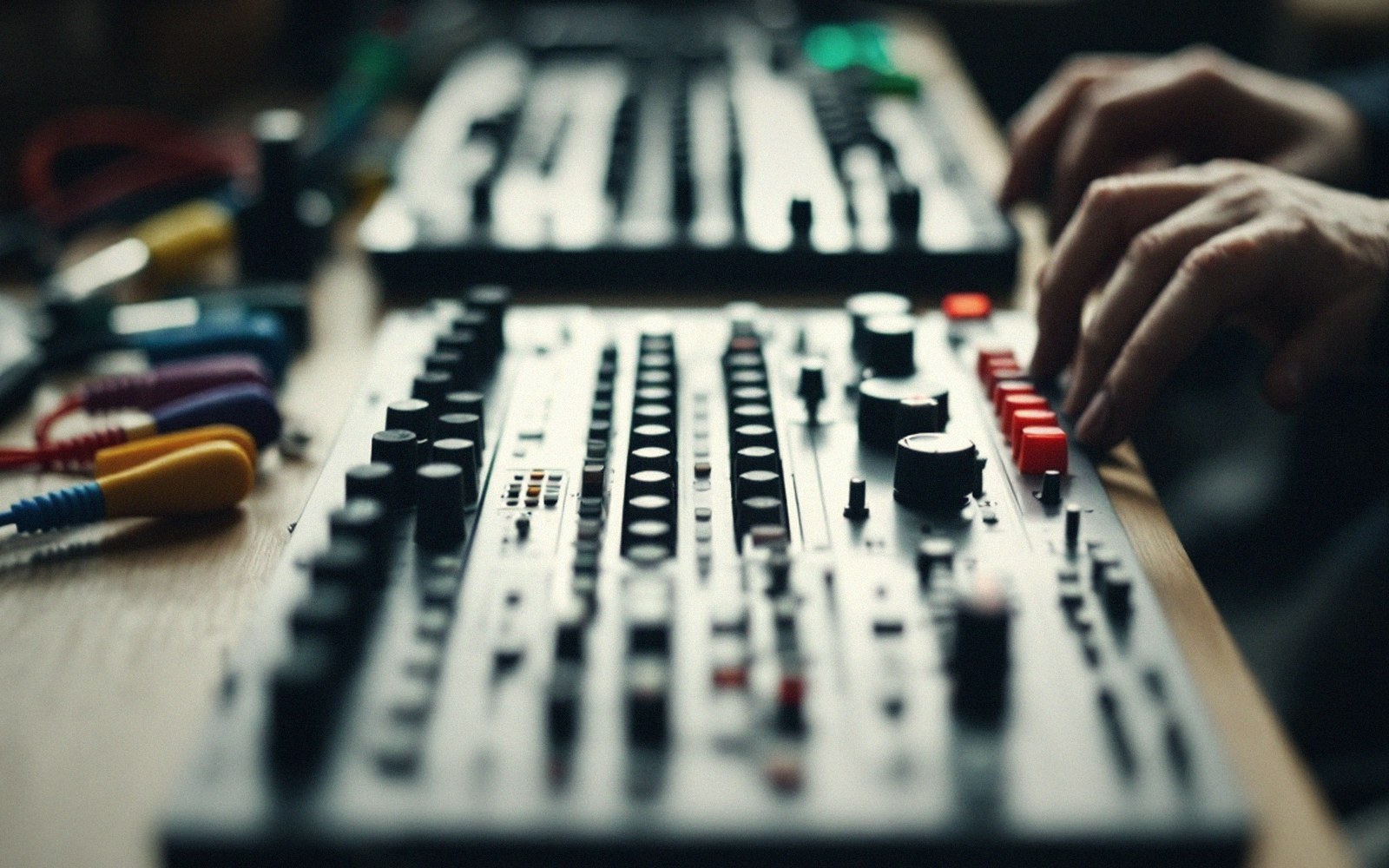
Hands adjusting knobs and red buttons on a synthesizer with patch cables nearby
Below a few hertz, modulation shapes a sound over time. Above it, modulation becomes the sound itself.

Through-Zero FM and Why It Sounds Different

Standard analog FM has a floor: the carrier frequency cannot be pulled below zero hertz by the modulator. As modulation depth increases and the carrier approaches zero, the waveform slows dramatically and the character changes — a kind of buzzy, asymmetric distortion rather than clean sideband generation. Through-zero FM removes that floor. When the modulator pulls the carrier below zero, the oscillator continues running but with its phase direction reversed. This symmetry is what gives through-zero FM its cleaner, more spectrally predictable result at deep modulation depths, closely matching the behaviour of digital FM synthesis as described by Chowning's model.

Ring Modulation: Both Sidebands, No Carrier

Ring modulation takes a different approach. Rather than varying the carrier's frequency, a ring modulator multiplies two signals together. The output contains the sum and difference of all frequency components from both inputs — and critically, neither original signal appears in the output. A carrier at 440 Hz multiplied by a modulator at 150 Hz produces components at 590 Hz and 290 Hz, nothing else. With audio-rate signals at both inputs, this creates dense inharmonic spectra immediately; there is no slow-modulation equivalent the way there is for FM. Ring modulation is inherently a timbral tool from the first cycle.

The common thread across all three techniques is that the ear's time resolution — its inability to track changes faster than roughly 20 Hz as discrete events — is the mechanism being crossed. Once you are on the audio side of that threshold, modulation and synthesis are the same act, described two different ways.

The three techniques contrasted

  • FM — modulator varies carrier's instantaneous frequency; sidebands appear at C ± nM; depth and C:M ratio are the two controls
  • Through-zero FM — same as FM but carrier phase reverses below 0 Hz; cleaner, more symmetric sideband behaviour at high depths
  • Ring modulation — multiplies two signals; output is sum and difference frequencies only; no carrier, no modulator present in output

Follow a cable